Identify arithmetic and geometric sequences
Key Notes:
Sequences
🔢 What is a Sequence?
- A sequence is a list of numbers arranged in a specific order.
- Each number in the sequence is called a term.
👉 Example: 2, 4, 6, 8, …
➕ Arithmetic Sequence (AP)
- A sequence where the difference between consecutive terms is the same.
- This difference is called the common difference (d).
📌 Key Points:
- Add the same number each time.
- Formula:
Next term = Previous term + d
- Common difference:
d = a2 − a1
✅ Examples:
- 3, 6, 9, 12 → (d = 3)
- 10, 7, 4, 1 → (d = -3)
👉 Tip: If numbers increase or decrease by the same amount → Arithmetic
✖️ Geometric Sequence (GP)
- A sequence where each term is obtained by multiplying the previous term by the same number.
- This number is called the common ratio (r).
📌 Key Points:
- Multiply by the same number each time.
- Formula:
Next term = Previous term × r
- Common ratio:
r = a2 / a1
✅ Examples:
- 2, 4, 8, 16 → (r = 2)
- 81, 27, 9, 3 → (r = 1/3)
👉 Tip: If numbers grow or shrink by multiplying → Geometric
🔍 How to Identify the Type
Step 1:
Check the difference between terms:
- Same difference → Arithmetic
Step 2:
Check the ratio between terms:
- Same ratio → Geometric
⚠️ Important Notes
- A sequence cannot be both AP and GP (except special cases like constant sequences).
- If neither difference nor ratio is constant → Not AP or GP
🎯 Quick Practice
Identify the type:
- 5, 10, 15, 20 → ________
- 3, 9, 27, 81 → ________
- 7, 11, 16, 22 → ________
👉 Answers:
- Arithmetic
- Geometric
- Neither
💡 Easy Memory Trick
- AP → Add Pattern ➕
- GP → Multiply Pattern ✖️
Learn with an example
🎯 Krysta is picking berries in the berry patch. She picks 36 berries from the first bush, 49 berries from the second bush, 64 berries from the third bush, and 81 berries from the fourth bush. What kind of sequence is this?
arithmetic geometric both neither
First, check if the sequence is arithmetic. There is not a constant difference between consecutive terms. So, the sequence is not arithmetic.

Next check if the sequence is geometric. There is not a constant multiplier between consecutive terms. So, the sequence is not geometric.

These multipliers are not all the same:
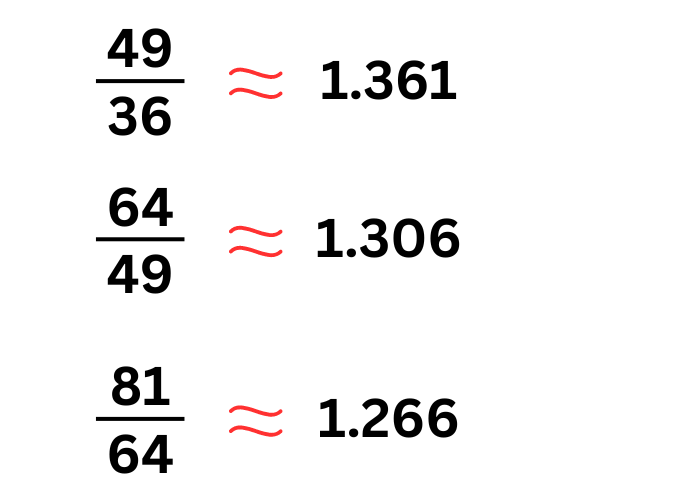
So, the sequence is neither arithmetic nor geometric.
🎯 Harper is organising her books and putting them on shelves. She put 218 books on the first shelf, 201 books on the second shelf, 184 books on the third shelf, and 167 books on the fourth shelf. What kind of sequence is this?
arithmetic geometric both neither
First check if the sequence is arithmetic. There is a constant difference of –17 between consecutive terms. So, the sequence is arithmetic.

Next check if the sequence is geometric. There is not a constant multiplier between consecutive terms. So, the sequence is not geometric.

These multipliers are not all the same:
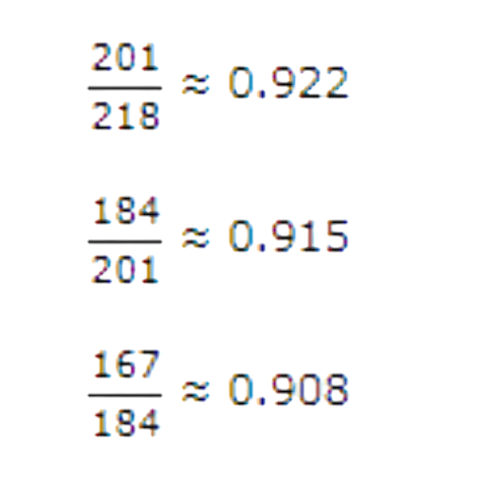
So, the sequence is only arithmetic.
🎯 What kind of sequence is this?
2, 3, 5, 8, …
arithmetic geometric both neither
First check if the sequence is arithmetic. There is not a constant difference between consecutive terms. So, the sequence is not arithmetic.

Next check if the sequence is geometric. There is not a constant multiplier between consecutive terms. So, the sequence is not geometric.

These multipliers are not all the same:
3/2=1.5
5/3=1.667
8/5=1.6
So, the sequence is neither arithmetic nor geometric.
let’s practice!