Sale prices: find the original price
Key notes:
🏷️ Sale Prices: Find the Original Price
🔑 Key Points
✨ Sale Price
- The price paid after a discount is called the sale price.
✨ Original Price
- The price before the discount is called the original (marked) price.
💯 Understanding Discount
- Discount (%) means how much is taken off the original price.
- Example:
- 20% discount = 20 out of 100 parts are reduced.
🧮 Formula to Find Original Price
👉 Original Price = Sale Price ÷ (1 − Discount Rate)
📌 Discount rate must be written as a decimal.
🔄 Convert Percentage to Decimal
- 10% = 0.10
- 20% = 0.20
- 25% = 0.25
- 40% = 0.40
✏️ Step-by-Step Method
1️⃣ Convert the discount percent into a decimal
2️⃣ Subtract it from 1
3️⃣ Divide the sale price by the result
🧠 Example
🛍️ A bag is sold for ₹600 after a 25% discount.
- Discount = 25% = 0.25
- 1 − 0.25 = 0.75
- Original Price = 600 ÷ 0.75 = ₹800
✅ Original Price = ₹800
⚠️ Common Mistakes to Avoid
❌ Subtracting discount directly from sale price
❌ Forgetting to convert % into decimal
❌ Using discount amount instead of discount rate
🌟 Tip for Students
- Always ask: “What part of the original price is left after discount?”
- Sale price is a fraction of the original price, not the full amount!
Learn with an example

Sebastian buys a desk during the sale. If Sebastian pays ₹45, what was the original price?₹——————–
Find the percent paid:
To find the percent paid, subtract the percent off from 100%.
percent paid=100%–percent off
=100%–75%
=25%
With 75% off, the percent paid is 25%.
Write an equation to solve for the original price:
Since 25% of the original price is equal to the sale price of ₹45, you can set up and solve an equation. Let p represent the original price.
25% . p=45
25/100 . p=45 Write the percent as a fraction
0.25 . p=45 Write the fraction as a decimal
0.25p/0.25=45/0.25 Divide both sides by 0.25
p=180 Simplify
The original price was ₹180.

What was the original price of a set of bunk beds whose sale price is ₹51?
₹——–
Find the percent paid:
To find the percent paid, subtract the percent off from 100%.
percent paid=100%–percent off
=100%–25%
=75%
With 25% off, the percent paid is 75%.
Write an equation to solve for the original price:
Since 75% of the original price is equal to the sale price of ₹51, you can set up and solve an equation. Let p represent the original price.
75% . p=51
75/100 . p=51 Write the percent as a fraction
0.75 . p=51 Write the fraction as a decimal
0.75p/0.75=51/0.75 Divide both sides by 0.75
p=68 Simplify
The original price was ₹68.
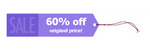
During the sale, Keith pays ₹20 for a kitchen table. What was the original price?₹——————-
Find the percent paid:
To find the percent paid, subtract the percent off from 100%.
percent paid=100%–percent off
=100%–60%
=40%
With 60% off, the percent paid is 40%.
Write an equation to solve for the original price:
Since 40% of the original price is equal to the sale price of ₹20, you can set up and solve an equation. Let p represent the original price.
40% . p=20
40/100 . p=20 Write the percent as a fraction
0.40 . p=20 Write the fraction as a decimal
0.40p/0.40=20/0.40 Divide both sides by 0.75
p=50 Simplify
The original price was ₹50.
let’s practice!